Cracks Spreading Across Your Asphalt? Why Sealing Them Early Matters
QUICK ANSWER: Asphalt cracks should be sealed early because every open crack lets water reach the stone base beneath the surface. In a cold climate that water freezes, expands, and pushes the crack wider, then thaws and leaves a void behind. Repeating that cycle each winter turns a thin line into a network of cracks and eventually a pothole. Hot rubberized crack filler, poured into a cleaned crack while the opening is still around a quarter inch or less, bonds to both walls and flexes with the pavement, which keeps water out and slows the spread.
Most people notice a crack the same way. You are walking to the mailbox or backing out of the garage, and there it is, a dark line running across pavement that looked fine last year. It seems harmless, so it gets ignored. The next spring it is wider, it has a few branches, and there is grit packed into it. By the following spring a corner of the driveway is starting to break apart. Nothing dramatic happened in between. Water simply did what water does in a cold climate, one freeze at a time.
What a Crack Actually Does to Pavement
Asphalt is a flexible surface sitting on a compacted base of crushed stone. The surface layer is only a shield. Its job is to keep water and weather off the base, because the base is what carries the weight of your vehicles. As long as the surface is intact, the base stays dry and firm. A crack breaks that shield, even when it is barely wider than a pencil line.
Once a crack opens, rain and meltwater run straight down into it. Some of that water soaks into the base and softens it. Some of it sits in the crack itself. Dirt, sand, and seeds wash in alongside it, and before long the crack has a small ecosystem of weeds and debris holding moisture against the edges. The pavement on either side begins to lose its grip on the crack walls, and the line gets wider even before winter arrives.
The cause of the first crack varies. Age and oxidation make the binder in the asphalt brittle, so it can no longer stretch as temperatures swing. Shrinkage cracks appear when the surface contracts in cold weather. Tree roots, heavy loads, and thin spots in the original pavement can all start a crack too. What matters for your maintenance plan is that the cause is usually not the problem you can fix. The open crack is the problem you can fix.
Why Frost Makes Everything Worse
Minnesota pavement lives through a long run of freeze and thaw cycles each winter, and a crack is the perfect place for that cycle to do damage. Water that has worked its way into the crack and the base freezes when temperatures drop. Water expands as it turns to ice, and that expansion pushes outward and upward with real force. The crack widens, the pavement edges lift slightly, and the base loosens.
When the ice thaws, the space it took up does not close back. Instead there is now a larger gap and a softer base, and the next round of water goes deeper. A single winter can see this happen many times during the stretches when daytime temperatures climb above freezing and nights drop back below it. Road salt and deicers carried onto a driveway add to the problem by melting snow faster and sending more liquid into every opening.
This is why a crack that looked minor in October can look serious by April. The pavement did not suddenly weaken. Each freeze and thaw cycle took a small bite, and the bites added up.
How a Thin Crack Becomes a Pothole
Following one crack through a few seasons shows how this works. In the first year, a hairline crack lets a small amount of water into the base. The base material under that spot loses some of its firmness, but the surface still looks mostly the same. In the second year, the crack widens and branches. Vehicles driving over the weakened area flex the surface slightly each time, and the flexing breaks the asphalt on either side of the crack into smaller pieces.
By the third year, those pieces start to loosen. A tire catches the edge of one, a plow blade nudges another, and chunks of pavement come out. What is left is a hole in the surface with a soft, wet base exposed underneath, and the hole keeps growing because the base around it has been undermined. At that point the repair is no longer a quick fill. The damaged pavement has to be cut out, the base material has to be addressed, and new asphalt has to be placed and compacted.
Crack sealing sits at the very beginning of that chain. It is the easiest point at which to interrupt it, and the only point where the repair takes a short visit and leaves the surrounding pavement untouched.
TIP: After the snow melts in spring, walk your driveway and look for cracks that have dark, damp lines or grit packed along them. Damp cracks are the ones taking on water, so they are the first ones to deal with.
What Hot Rubberized Crack Filler Does
Not every crack product behaves the same way. A thin liquid poured into a crack tends to shrink, harden, and pull away from the walls after a season or two, leaving a gap that looks sealed but is not. Hot rubberized crack filler works differently because of how it is made and applied.
The material is heated until it melts into a pourable liquid, then placed into a crack that has been cleaned of dirt, loose asphalt, and moisture. Preparation matters as much as the material. Hot sealant bonds to clean, dry crack walls, and a crack full of dust or damp debris will not hold it. Once poured, the sealant flows into the opening, grips both walls, and cools into a flexible rubber like plug.
The flexibility is the key feature. Pavement is never completely still. It expands in summer heat and contracts in winter cold, and the crack opens and closes slightly as that happens. A rigid filler cracks or tears away under that movement. Rubberized material stretches with the crack and returns to shape, so the seal stays intact through the seasons. Sealing cracks at roughly a quarter inch wide, while the walls are still solid and the base underneath is dry and firm, gives the sealant the best chance to hold.
Sealing Early Versus Waiting
The difference between early and late is easier to see side by side. A narrow crack in sound pavement is a clean job. The opening is small, the walls are strong, and the base underneath has not been disturbed. Sealing it keeps the structure as it was built.
A crack that has been left for several winters is a different situation. The opening may be wide and ragged, the pavement edges may be crumbling, and the base beneath may already be soft. Sealant poured into that opening has weak walls to bond to and a loose foundation under it. Sometimes the work shifts from sealing to patching, cutting out the damaged area and replacing it with hot mix asphalt. And when cracks have joined into a connected web across a larger area, patching individual spots stops making sense and the conversation turns toward the condition of the whole surface.
None of that means an older crack cannot be helped. It means the repair gets bigger the longer the crack stays open. Early sealing keeps you in the small repair category.
Crack Sealing and Sealcoating Work as a Pair
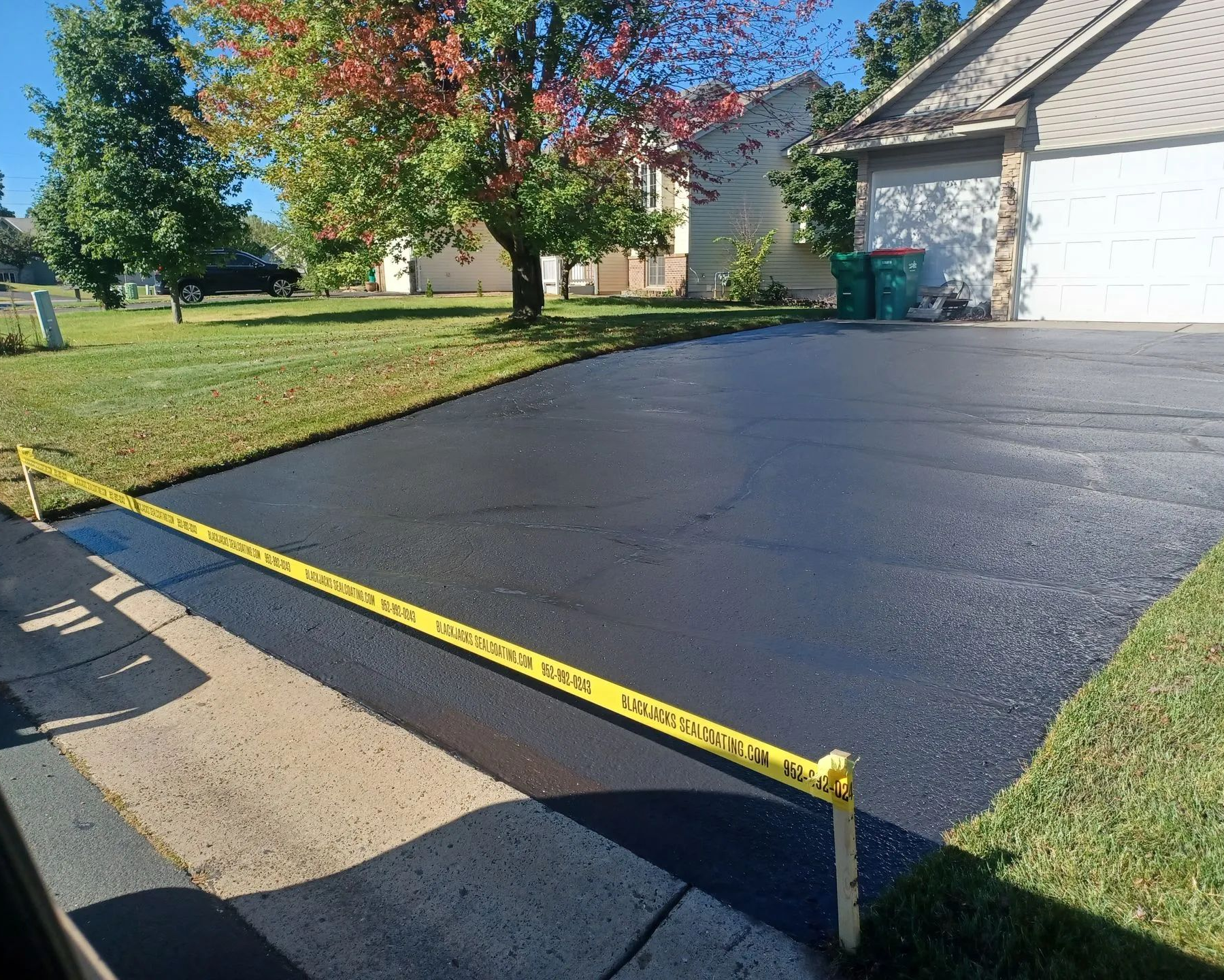
Crack filler and sealcoat do different jobs, and they work best together. Sealcoat is a thin protective coating applied across the whole surface. It shields the asphalt binder from ultraviolet light, rain, and road salt, and it restores the deep black color. What it cannot do is bridge an open crack. A coat of sealer over an unfilled crack mostly runs into it and disappears, or it covers the opening briefly and then breaks open again as the pavement moves.
The right order is to fill cracks first, let the filler set, and then apply sealcoat over the repaired surface. The filler closes the openings so water cannot enter from above, and the sealcoat protects the pavement around those repairs from the weathering that created the cracks in the first place. Done together, the driveway gets sealed at the points where it was breaking down and shielded everywhere else.
Sealcoat is generally reapplied every two to three years on a residential driveway, and that schedule is a natural time to check on cracks. Each visit is a chance to catch new lines while they are small.
WARNING: Do not pour a liquid patching product from a hardware store into a wide or deep crack and consider it sealed. Cold applied fillers often shrink and pull away from the crack walls, which leaves a hidden gap that still lets water reach the base.
Signs a Crack Needs Attention Soon
You do not need special equipment to tell which cracks deserve attention first. A few clues stand out. Cracks that are wider than about a quarter inch deserve a closer look because they are well past the hairline stage. Cracks with a lip, where one side sits higher than the other, suggest the base underneath has shifted. Cracks that branch into smaller lines are spreading and may be early alligator cracking, which points to a flexing base rather than a surface issue. Cracks with grass or weeds growing in them have been open long enough for roots to take hold, and those roots keep prying the pavement apart.
Location matters too. Cracks near the edge of a driveway are exposed to water from both the surface and the soil beside the pavement. Cracks in low spots where water collects take on more moisture than cracks on higher ground. And cracks that sit in a tire path get flexed every time a vehicle passes, which speeds up the damage.
When Timing Works in Your Favor
Crack sealing needs dry conditions and a crack free of moisture, so the work belongs in the drier, warmer months rather than in the middle of winter. In Minnesota, late spring through early fall is when the pavement is dry enough and the weather steady enough for the sealant to bond properly. Fall is a particularly good time to seal cracks, because closing them before the first hard freeze keeps meltwater out of the base all winter and prevents a whole season of frost damage.
Spring is just as valuable for a different reason. Winter exposes exactly which cracks opened up, so a spring walkthrough shows where the new damage is. Sealing those cracks before summer storms and the next cycle of freezing temperatures gives the pavement the longest possible stretch of protection.
Frequently Asked Questions
How wide does a crack have to be before it needs sealing?
Any crack open enough to let water in is worth sealing, and many are sealed at around a quarter inch or less. At that stage the walls are strong and the base stays dry.
Can I just sealcoat over my cracks instead of filling them?
Sealcoat is not designed to bridge open cracks. It may cover a hairline for a short time, but it will not stop water from entering. Fill cracks first, then apply sealcoat.
Why do cracks seem to get worse every winter?
Water collects in the crack and base, then freezes and expands. Each thaw leaves a larger gap and a softer base, so the next cycle goes deeper and the damage builds.
Does crack sealing fix a driveway that is already sinking or flexing?
No. Sealing protects pavement that is still structurally sound. Sections that dip, flex, or show alligator cracking point to base failure, which needs patching or replacement.
How long does crack filler last?
That depends on preparation, crack width, and pavement movement. A clean, dry crack filled with hot rubberized material holds up through many seasons, and checks every couple of years catch any spots that reopen.
Is it a problem if grass or weeds are growing out of a crack?
Yes. It means the crack has been open long enough to collect soil and moisture, and roots will keep widening it. Clear the vegetation and debris before sealing.
Early Crack Sealing Keeps Pavement Problems Small
A crack is the first message your pavement sends that it needs attention, and reading it early is easy. Waiting costs the surface a little more every winter, even when nothing looks different from week to week. Sealing cracks while they are still thin keeps water out of the base, keeps the surface tight, and keeps a manageable repair from growing into a full project. Walk your driveway this season, look closely at the lines, and deal with them while the fix is still small.
After 35
years of experience working on pavement in Anoka, MN, Blackjacks Sealcoating
has watched countless driveways hold up or break down based on how soon the first cracks were handled. Clean preparation, hot rubberized filler, and timely sealcoating protect the base through every freeze and thaw. Properties that follow that simple routine tend to keep their surface smooth, their edges solid, and their repair costs low, season after season, without the surprise of a sudden pothole.